Lavinia Kumar

Marriage License in ‘60s Boston

A line on the form asked words –
black or white. 
We asked brown?

The careful clerk consulted
the civil service bible.
It listed B’s birthplace White
north Indians white,
south Indians black.
Irish always white.

B and I ease into this allowed
cargo space
the White list.
My chic French wedding suit to match

and no quandary for the judge,
formal in black robe.

______________________________________________________
About the author
Lavinia Kumar’s latest book is Spirited American Women: Early Writers, Artists, & Activists – very short prose biographies of near 90 amazing pre-Civil War women writers, poets, publishers, painters, artists, abolitionists, early suffragettes, and activists. She is author of 3 poetry books (most recent, No Longer Silent: the Silk and Iron of Women Scientists) and 4 chapbooks (most recent, Beauty. Salon. Art.; Desert Willow Press). Her website is laviniakumar.net

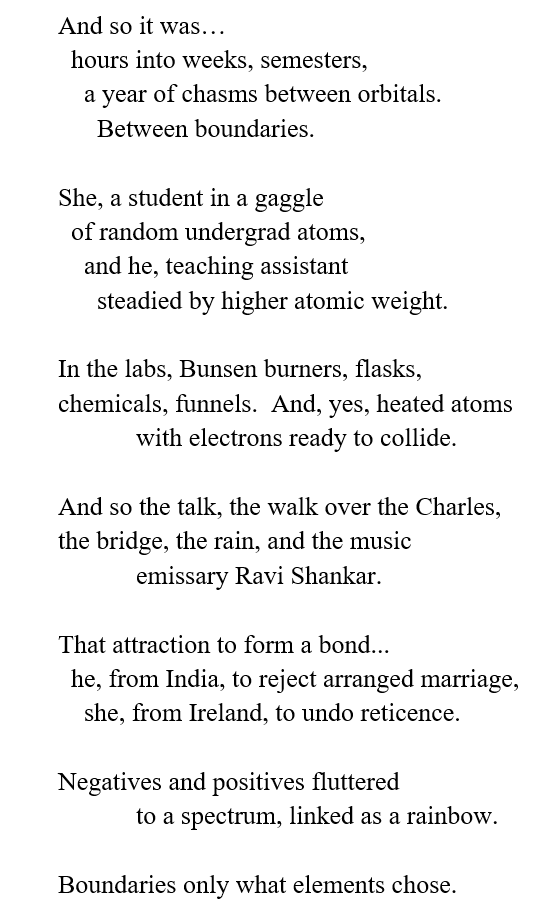
Lavinia Kumar

Two Immigrants Meet in a Chemistry Lab

___________________________________________________________________________
About the author
Lavinia Kumar’s latest book is Spirited American Women: Early Writers, Artists, & Activists – very short prose biographies of near 90 amazing pre-Civil War women writers, poets, publishers, painters, artists, abolitionists, early suffragettes, and activists. She is author of 3 poetry books (most recent, No Longer Silent: the Silk and Iron of Women Scientists) and 4 chapbooks (most recent, Beauty. Salon. Art.; Desert Willow Press). Her website is laviniakumar.net

Ilene Dube

Metamorphosis

Aldous was on Zoom with his parents when the words appeared in a window on his laptop screen: There’s a backpack in the alley between our houses.

“I have to take care of a situation,” Aldous abruptly alerted his parents. “Do you want to keep talking to Eli?”

Eli was 3, but could keep up a conversation. He liked to tell his grandparents about his toys – the trolley he’d fill with Daniel Tiger and Margaret – or show his Baby Shark coloring book. Orange was Eli’s favorite crayon and he’d make every shark the color of the desert sun.

Aldous and Kaylee moved to the desert five years earlier. There had been job offers, but they also liked hiking in the canyons, visiting Tohono O’odham sites, and the culinary diversity that made Tucson a Unesco World Heritage Site. What had surprised them were the numbers of encampments along the Rillito River. At first Aldous had thought it was campers out there, until he saw some of the evidence that these were their homes. 

Since moving into their adobe ranch, where Eli was conceived and born, they had spoken few times with their next-door-neighbor, mostly about the weather or droppings from the mesquite trees. Pete’s wife – Aldous didn’t even know her name – passed from house to car in the garage, and Aldous wasn’t sure he’d recognize her if he ran into her.

Pete was already there in the alley. Both Aldous and Pete were vigilant about keeping the aggressive weeds from taking over in that space between their houses. The alley had the scent of dry desert sand and seemed to give life to the most vicious of plants such as datura, a deadly hallucinogen.

There sat the backpack, a green JanSport.

It looked familiar – Aldous remembered he’d had one like it in college, and had used it for hiking and for toting books. It was well-made, but after years of use had become frayed and had to be replaced. In fact the old one might still be in his garage. Or was this his backpack? At first he’d wondered if Pete thought it was his. As he got closer he saw that it held a keychain from which dangled items that were decidedly not his – lip balm, hand sanitizer. There was a flashlight that at first looked like his but was scuffed up in a way that his was not. Aldous knelt to inspect it.

“Stand back,” warned Pete. “Don’t touch it.”

Aldous, a runner, thought of the backpacks that had detonated at the Boston Marathon. “What do you think is in there?”

“I have no idea where it came from – I thought maybe you would.”

Aldous was not about to let on that its soft body reminded him of an earlier time in his life.

“I think we should call the police.”

Two patrol officers drove up in a white Road Runner with ghosted lettering on the door. They examined the backpack and determined it must have been left by a person from one of the encampments. They did not detect explosives. With gloved hands and a large prodder, the patrolwoman worked with her partner to place it in a heavy black plastic bag they loaded into their vehicle.

“But what if the person comes back looking for the bag?” Aldous’s mother wondered, when he returned to the Zoom call. That was the unfortunate part about having this happen during a family call—now she’d be asking about it for weeks. This was just the sort of thing to pique his mother’s curiosity. Once, while visiting, passing the encampments, she remarked that the people seemed like some of the hippies of her generation who’d gone camping but never returned home.

Eli didn’t like when they talked about things that were not related to his toys, so he spoke louder, reading from one of his truck books. “This is a forklift,” he said, holding up the picture.

“Ooh, and it’s orange—your favorite,” said his grandmother.

“Yes, I love orange,” said Eli.

“Are there homeless people in your neighborhood?” Aldous’s mother persisted. “Did you check the woods at the end of your cul de sac? Could there be an encampment there?”

Kaylee usually stayed off-screen so she could avoid all the questions.

It was Kaylee who answered the front door a week later when a woman showed up asking for water. In the desert, you never deny anyone water. The stranger held out an empty Nalgene bottle.

Aldous came to the door with a large plastic jug and poured it into the woman’s bottle. It was fairly beat up—Aldous remembered he’d had one like that years ago, when he’d hiked a portion of the Appalachian Trail. It had been a good water bottle, made to last, and he might still have it packed away somewhere—his was equally beat up.

“Thank you,” said the woman in a somewhat husky voice. Aldous looked up at her. She appeared to be his age, maybe several years older. With strawberry blond hair tied in a braid, she reminded him, a bit, of his girlfriend in grad school. Mariah, tall and graceful, with that striking head of hair, had been in his life for a year, and while you could check all the boxes on her qualifications as romantic partner, Aldous didn’t feel like she was the one. Not like what he felt when he eventually met Kaylee. As far as Aldous knew, Mariah had met someone else and was still in the Northeast.

“Will that be enough? I can give you another bottle,” offered Aldous.

The woman smiled. There were small holes in her T-shirt, her hair was escaping its braid, and her skin looked as if it hadn’t been washed. “I’ll let you know,” she said, then turned and walked back down the pathway.

“Don’t tell your mom,” said Kaylee. “She’ll want to know if it’s the same person who left the backpack.”

“Could it be?” Her clothing looked as if it could have been bought from the same camping goods supplier.

Later that day, while Kaylee took Eli to Costco, Aldous looked up Mariah on Facebook. She was, indeed, still living in the Northeast. With a husband and a little boy the same age as Eli. There were pictures of her just after the birth of her son, holding him, and then there were mostly photos of the baby. In the postpartum photos, Aldous saw she was still wearing the pendant he’d given her, a tree of life carved into an ancient bronze coin.  It seemed she was working with a team creating solutions for affordable living. She had written her thesis on housing solutions for the unhoused.

Not that Kaylee would examine his search history, but Aldous cleared his cache. He rarely thought about Mariah, only needed to assure himself that the woman who’d shown up for water could absolutely and positively not be her.

Several days later, Aldous and Kaylee set up the pool in their courtyard for Eli. Aldous put up the beach umbrella to provide shade, and he and Kaylee sat on the patio chairs while Eli poured water from one vessel to another and talked about his toys and their colors and shapes. “One-two-three-four-six,” he said of the five little boats he put on the water. Kaylee was grading papers and Aldous was catching up on the news when they heard a knock at the courtyard door.

Aldous rose to crack the door ajar. It was the woman with the strawberry blond hair. She looked dirtier than she had the other day. “I can clean your house,” she offered in a small voice.

“No thanks,” said Aldous, about to close the door.

“Ask if she has a business card,” called Kaylee.

The stranger shook her head.

Kaylee got up and came to the door. “We have to think about it,” she said. “Can you give my husband your name and your number and we’ll get back to you.”

“My name is Maria,” said the stranger.

Aldous opened his notes app and keyed in the phone number she gave. He saw that she had a gold cross around her neck—definitely not Mariah.

“We’ll give you a call,” said Kaylee and shut the door on Maria.

“Would you want her to clean our house?” asked Aldous.

“Definitely not,” said Kaylee, then added, “well, maybe it would help her out.”

When returning from a run, Aldous checked the cul de sac. There was no sign of an  encampment. A neighbor out for a walk with binoculars around his neck told Aldous that a javelina family had taken up residence in the woody area. On other morning runs, Aldous saw coyotes prowling. There were tarantulas that dug holes in the desert sand. Aldous had lived most of his life in suburbs of the Northeast, and he liked that Tucson, a city, had so much wildlife.

Eli’s interests in vehicles evolved into an interest in dinosaurs, and he began to identify them as tyrannosaurus Rex, stegosaurus, triceratops and all the rest. Orange was still his favorite color. For a present, his grandmother sent him caterpillars that would turn into painted lady butterflies.

Aldous was invited to give a talk at Palomar. It was a hot afternoon, and Kaylee set up the pool for Eli in the courtyard. The water was running from the hose into the pool, and Eli, in his swimsuit, was putting toys in the water. Kaylee remembered she’d left her phone inside the house and said to Eli, “I’ll be right back. Don’t go into the pool until I’m back.” She quickly went in the front door, looking for her phone. It wasn’t where she had thought she’d left it on the counter. She peeked out the front door—Eli was quietly putting his water toys into the pool and obediently remaining outside of it as the water filled, about two inches high. She ran into the bedroom to look for her phone.

Back at the front door, Kaylee saw Maria squatting, helping Eli put toys in the pool. Eli was smiling at her.

“Hello!” shouted Kaylee.

Maria looked up. “Hello. Your boy is so smart.”

“Yes. Thank you.”

“My son is about the same age.”

“Oh?”

“But I haven’t seen him in a while.”

Kaylee gripped her phone. “Can I get you some water?”

“OK.”

Kaylee opened the door. “Eli, can you go inside and get one of those water bottles from the refrigerator.”

Eli looked up at Maria, and then at his mother, then back to Maria. “I have caterpillars,” he told her. “They will turn into butterflies.”

“Eli, please get one of those bottles.” She was trying to sustain the little voice she used when speaking to Eli. “Can you please get it, sweetie?”

Eli ran into the house and came back with the bottle. “But first they have to turn into chrysalises.”

“Good boy,” said Kaylee, taking the bottle and handing it to Maria.

“Thank you,” said Maria, also adopting the little voice.

“We don’t need our house cleaned,” said Kaylee.

“OK,” said Maria. She opened the bottle and closed her eyes, taking a sip that seemed to go all the way into her soul.

Eli grasped the hose and held it up so that he could drink from it.

“No, Eli, no,” said Kaylee. “We told you not to drink the hose water.”

Not happy to be reprimanded in front of a visitor, Eli continued drinking.

“OK, that’s it; no more pool today,” said Kaylee. “Time for a time out.” She turned off the hose, grabbed Eli around his ribcage, carried him inside and slammed the front door. Eli wailed as Kaylee went to the front window and saw that Maria had vanished.

“What happened to the lady with the orange hair?” Eli asked through a whimper.

Kaylee didn’t tell Aldous about the incident until he returned home. They talked about putting a lock on the courtyard gate. They talked about getting a surveillance camera. But what would a surveillance camera do? Pete had a surveillance camera. It showed a shadowy figure walking around the night the backpack was left. It hadn’t proved useful to the police.

Pete’s wife, they learned, was a critical care nurse who often came home in the wee hours. One night, upon arriving, she discovered the battery in her electric garage door opener had died. She left the car in the driveway, entering through the front door. And that was the night that someone went into her car and took her wallet. Again, the security camera picked up a shadowy figure going into the car and leaving, but it was of no use to the police.

A few weeks later, Aldous went out the front door, through the courtyard, to get the mail. Lying in the courtyard was a brown quilted sleeping bag. It reminded him of one he’d had as a teenager. He looked around and didn’t see anyone. He slowly approached the sleeping bag, wondering if there was someone inside. No, it was too flat. He saw a gecko crawl away, and then he noticed a glint just before the crevice the gecko slipped into. It was, Aldous saw, a gold chain with a cross.

The patrol car came again to examine the sleeping bag. There was no identifying information. Aldous pointed to the gold cross, and one of the officers picked it up and put it in an envelope she put inside the black plastic sack with the sleeping bag. “Probably a homeless person,” the officer said, though not the same officer who had come the last time. Aldous wondered if they’d kept a record of the backpack, if they connected the two. And the person who took the wallet.

“There’s a woman who’s been showing up around here,” Aldous said. “She asked for water once, and another time she said she wanted to clean my house.” Aldous thumbed through his apps and found the phone number, repeating it to the officer.

“Not a working number,” the officer said after trying it, then drove off with the other officer who’d remained inside the vehicle the whole time.

Pete came out just as the patrol car drove off. “Something happen?”

Aldous explained about the sleeping bag. Pete said he’d check his surveillance video. As if a mirage, a woman appeared in Pete’s garden, pulling weeds. From under a wide-brimmed hat, strawberry blond hair cascaded down her shoulders. She looked as if she were freshly showered, and in new clothes. “There she is,” Aldous said.

Pete turned and looked at her. “I know, she hardly ever comes out of the house,” Pete said. “My wife has such fair skin.” The woman turned her head and looked at them.

When Aldous went back inside, Eli was running around, excitedly. “The chrysalis turned into a butterfly!” he said. “It’s orange!” Together, Aldous and Eli went outside and released the butterfly. The orange-haired woman working in her garden looked up and watched the painted lady attempt to fly. It would take some time before the butterfly would disappear into the sky.

_________________________________________________________
About the author:
Ilene Dube is a writer, producer, curator, and artist. Her short fiction has appeared in more than a dozen literary journals and anthologies. Kelsey Review has published nine.

Elane Gutterman

Inheriting My Grandmother’s Foot

In my young eye, her foot with its twisted
big toe was the problem, though
more likely it was her hip. She barely walked
to the mailbox, a block away. She plodded

in her black, old lady shoes as she mothered,
wifed, grandmothered. No running
on pliant sand, cooling her heels in the ocean,
climbing to peaks, rowing against currents.

She toed life’s lines    kept her feet
on the ground.      She footed the bills
withstood     the burdens of her life.
She put her best foot     forward.
I have grown     into her foot     one day
her foot     in my grave.

________________________________________
About the author:
Elane Gutterman’s recent poems have appeared in The Ekphrastic Review, The Fib Review, The Kelsey Review, The New Verse News, and Shot Glass Journal. She has been nominated three times for a Pushcart Prize. Her first book of poetry, Tides of Expectation, was published in 2022 (Kelsay Books). She is Chair of the Literary Arts Committee at the West Windsor Arts, where she is also a founding board member.

Barbara Krasner

Stones Tell No Lies

Jake ran his hand through the scant strands of hair left on his head. “I don’t know my grandmother’s name. If I did, it would make both our lives easier.”

The Jewish records office clerk narrowed her eyes. “Without a name, how can you expect me to find information?”

“I know, I know.” Jake recognized these clerks were overworked, forced to deal with cramped working spaces and withering, yellowed papers and folders. Oh, what technology could do to help these people.

The clerk pleaded as if her life depended on it. “Can you give me anything, anything at all?”

“Let me think. She died in 1937. Her first name was Yetta. She and my grandfather had a bakery in the 18th arrondissement.” Maybe Bubbe used that name here in Paris? He didn’t know. He really didn’t know. He wanted to be more helpful. He prided himself on being a man of service, helping others in whatever way he could. He never forgot his grandmother’s mantra of tikkun olam, repair the world. And that was before the roundup at the Velodrome.

The clerk tried again. “A last name would be more helpful.”

“I’m certain it would, but I don’t know it. Maybe it began with an F. Feldman, Feldstein.”

“Let me try that.” She stepped away from the service counter and into some back room. While she was gone, Jake surveyed the room. Any number of secrets could be hidden here among the many doorways and file drawers. How could he tell the clerk it was still a secret to him how and why he was even in Paris looking for his grandmother’s gravesite? One night a sort of wave enveloped him as he lay in bed staring at the light fixture. An invisible voice whispered, “Go to Paris. Find me.” It was his bubbe’s voice.

The clerk returned, snapping him out of his thoughts. “I have a Bertha Finkelstein. She died in 1937. Could that be her?”

“I don’t know, I don’t know.” Nothing stirred in his heart. Bertha Finkelstein could not have been his grandmother. He remembered once seeing an envelope in her flat with a surname. He tried to bring it up in his mind’s eye like rolling back a movie film frame by frame. If this were his father’s mother, he’d know the name. It would be his own, artificial as it was: Beignet changed from Beninson. What a stupid name his grandparents used. What a stupid name they gave to Jake’s father. Artificiality was the game his father’s family played like insisting on plastic slipcovers for the living room furniture. Making only rustic French dishes like cassoulet or ratatouille. Nothing fancy. Nothing so-called “ethnic.” Nothing kosher, because you didn’t want to be seen patronizing a kosher butcher. No, definitely nothing Jewish. Don’t call attention to yourself. Don’t touch. Don’t feel. Don’t argue. Don’t complain. Go to school in uniform. Cut your hair the same way as everyone else. Have a bland, common French first name.

True enough, Jake had been named Jacques. He adopted the name Jake when he arrived in the United States. No one in his school could really deal with his French name. Even Beignet became Ben-Gay like the arthritis ointment. It stuck.

But his mother’s parents had been more inventive. They might have done a straight translation of the family name like Weissberg to Montblanc. Again he tried to bring that envelope into his memory. He could almost see the handwriting, the flourishes of the capital letters. A “B?” No. A “K?” That could have plenty of embellishments. It couldn’t be an H, because the Russian alphabet had no such letter; they use a G instead. An “F.” Yes, an “F.” But he had to figure out both the French version and the original version from some Russian shtetl. They were from White Russia, that he knew. That they’d come after World War I like so many others. Most of France’s Jewish population at that time, before the occupation, had not been born on French soil.

“Feldman, Feldstein. A field in French is champ. Man is homme. Champhomme?”

The clerk shook her head. “Ridiculous.”

Jake nodded in agreement. “What about Champion?”

“Champion? Yetta Champion?”

“Maybe?” Who knew?

The clerk disappeared into the back room again. She returned quickly with a tall, leatherbound ledger book in her gnarled hands. “Yetta Champion. Died April 1937.  Boulevard du Montparnasse. That’s in the fourteenth.”

Could this be her? Could this be his beloved Bubbe? The marrow in his bones stirred. “Any mention of a husband?”

“Solomon.”

Shloyma, Solomon, of course. Eureka! “That’s it. That’s him, that’s her! Yetta Champion.”

The clerk continued to read. “Solomon Champion died in 1932. They’re both buried in the Jewish section of the Montmartre Cemetery in the eighteenth.”

“Where exactly?”

She began to write on a piece of paper. She stopped. “But there’s more.”

“What do you mean?”

“I thought the name sounded familiar. Have you never heard of the Champions? They were actors in Paris’s Yiddish theater. That’s why they probably lived in Montparnasse.”

“My grandparents, actors? That can’t be possible.” How could Zayde be known for his tarts and be on stage at the same time? If this were true, and he wasn’t admitting this to himself just yet, there would be much more to research. He never really knew his grandparents at all.

Jake dipped down into the metro. He checked the map for his destination. He tried to pretend he was a Parisian again, although he never really felt like one even though he was born here. French was not the language spoken at home. His first day at school had been a nightmare because he only spoke Yiddish. That was the day he learned he was different, other. After that, his grandparents hammered it into his head. “Remember you come from a rich heritage,” they said. “Be proud of who you are.” Yet they changed their names. His parents told him to blend in yet remain Jewish.

After the Nazi invasion, his father said at the kitchen table, “Yankel, you are a Jew. Don’t ever forget that.”

“But Papa, if we weren’t Jewish we wouldn’t be facing arrests and being beaten,” Jake said, letting the bubbles of the seltzer hit his face. They made him sneeze.

“We don’t know what’s to come,” Papa said. “But we’ve survived many centuries. We’ll continue to survive.” He spritzed more seltzer into his glass and Jake’s. He gulped his. Jake sipped his.

How would Jake tell him? To be a Jew meant danger, even death. Denouncing his faith, although he was too young to use those words now, was his only solution.

“Yankel, we’re going to leave this place and somehow get to America. We’re going to go to Spain and then Portugal, to Lisbon and get a boat to New York. There we will practice the traditions. You will be bar mitzvahed in New York.” The sun was setting behind the city’s buildings behind his father. All orange and red, sinking and skulking behind the dark silhouettes.

“No, Papa,” Jake wanted to say. He wanted to pronounce, “I will not be a Jew. I hope I can still be your son, without stepping into a shul, without praying, without a yarmulke or prayer shawl, without a Bar Mitzvah.” But he said nothing.

Papa said nothing. Did nothing. He just stared at Jake. Papa finally stood and put the glasses in the sink to rinse. “You’ll see, everything will change for the better once we leave France.”

Jake sat back against the chair, nestling his shoulder blades. He was done with it, with Judaism, for good. He didn’t want to die for being born a Jew. If there were a way to get uncircumcised, he aimed to find it, in France or in America.

Now here he was forty years later in Paris, in a Jewish cemetery, trying to pay homage to his grandmother. Jake cried out to Bubbe in his head. He implored, “Help me find you!” But no response came except the drizzle of rain that was Paris. Here he was, a grown man, an elderly man if truth be told, and he felt five years old, spritzed in the face by a cousin and a seltzer bottle in Bubbe’s kitchen. No one came to his rescue then and no one came now. He glanced at his watch. He’d been walking around this vershtinkeneh cemetery for nearly three hours even with the clerk’s note with the cemetery address and grave locations. He would just have to face facts. He was inept. He was incapable. He could not find Bubbe’s grave. He had been stupid to come to Paris for a stupid reason. It’s not like finding her grave would bring her back to life. But no one could erase his memories, how he recalled her and Zayde in his mind’s eye.

He ambled out of the cemetery and soothed his nerves in a brandy at a nearby cafe. More than one brandy. More than one cafe. The streetlights turned on as he swaggered into the hotel lobby, a doorman offered assistance. “I’m fine, I’m fine,” Jake insisted, although he tripped over the clawfoot of an ottoman and the doorman steadied him. He staggered to the elevator and then to his darkened room. He did not turn on the lights but fell face first onto the bed. The pillowcase felt cool and soothing.

Jake closed his eyes. The room continued to swirl like a maelstrom around him, the same kind of chaos that surrounded him and his family when they fled France in 1940. Only the sound of rain against the double-paned windows reminded him he was in Paris. A small voice emerged from the spaces between raindrops. A voice that grew increasingly louder until it practically boomed in his ears. “Yankel,” it said in a Yiddish accent. “You gave up too early. Too early on yourself and too early on me.”

His eyelids flew open and his nostrils flared with the scent of…rose water. 

“Bubbe?” 

“Yankele, yes, it’s me. You get up early, listen to me boychik, you get up early and go back to the cemetery. You can find me. I will help you.”

“Yes, Bubbe.” Only now he remembered those pastries she made with rose water. She marinated apple slices in rose water, rolled them into puff pastry to create roses, and baked.  The sweet smell of roses always strangled him, but now its sweetness reminded him of happier times when the family gathered at home or in the bakery. When everyone was still alive.

Who was he to disobey his grandma? Jake returned to the cemetery. Once again, he read the paper from the records office with the location. Once again, he struggled. He walked around and around, stumbling over exposed tree roots and broken pathways. The silence of the cemetery pounded in Jake’s ears so hard, he put his hands up to them. But as he did this, time stopped. His hands moved slowly as if were a marionette and someone stood above manipulating his strings. He caught the scent of rose water.

“Bubbe?” he asked out loud to no one. A breeze whipped up and he turned his head to the right. There was Bubbe Yetta’s grave. And an apple rose in his hand.

Yetta and Shloyma. In Hebrew were the real surnames and their heritage: Yetta bat Avraham Hacohen and Solomon ben Arye Leib Feldman. He recited Kaddish. “A shaynem dank,” he said out loud to no one. He found her, found Grandpa. Mission accomplished, with a little help perhaps. We all needed a little help sometimes, he told himself. A sensation bubbled inside of him like a seltzer bottle shaken, ready to explode. Jake wanted to call home. But who would he call to tell he’d found his grandmother’s grave? His parents were long gone.

He stooped down to pick up stones he could place on the grave as a sign of his remembrance. One for each of his parents, one for himself. As he lifted himself up to place the three stones, his mouth opened wide. There were already stones on the grave. Who could have done that?


Jake checked the address the burial office had given him on a slip of paper. Whoever owned his home was paying for perpetual care of his grandparents’ graves. He placed his left hand over his right hand to quiet the tremors. He stared at the doorknob in front of him, an ornate one, perhaps from the early twentieth century. He pressed the doorbell. Even the sound of it sounded inherited and privileged. He stepped back from the threshold, not knowing what to expect. A servant opened the door and led Jake into the grand foyer of marbled floor and vaulted ceiling with an extravagant chandelier only gloved hands could clean.

“Monsieur, this way, please,” the servant said. He guided Jake into a wood-paneled room, a library with ample seating of tufted chairs and velvet sofas. “Madame will join you in a moment. I will bring some tea.” He backed out of the room as if Jake were royalty, but maybe that’s how this person had been trained. Jake himself came from peasant stock, this he knew.

An elderly woman wearing vintage Chanel glided into the room, her neck covered with strands of pearls. He knew that necklace or thought he did. It was his grandmother’s. “Monsieur Beignet.” she said, her words sliding off her tongue to her hand that awaited his enchanté. “Please sit.” Jake chose one of the tufted chairs separated from Madame by a marble cocktail table decorated with Limoges pieces.

“I believe you knew my grandparents,” he said.

“Indeed, I did.”

“So it was you who remembered them in the cemetery.”

“With the stones, yes.”

“May I ask?” Words fought with each other on Jake’s tongue. “How you knew my grandparents?”

“Mon Dieu, you don’t know?”

He shook his head.

“I am your aunt. Your mother’s youngest sister. Your grandparents were my mama and papa.”

Jake sat forward. “That cannot be. I’ve never heard of you.”

“Do you need to hear of something to make it true?”

He no longer needed to accomplish a mission. This woman, if she was really his aunt, already was doing it and with more panache than he could possibly muster. Plus, she was local.

“Do you have children?” he asked.

“You’re really asking whether someone will care for these graves when I’m gone, yes?”

“Well, yes.” She looked not at him, but through him as if he were a piece of plastic with all his innards hanging out.

“Why have I never heard of you?” he asked. The servant returned with a tray of tea and pastries.

“I didn’t get along well with the family. I decided to marry a diamond merchant originally from Antwerp, you see.”

“This was a bad thing?” He hadn’t even picked up his teacup yet.

“My sister, your mother, thought I had forgotten where I came from. Had gotten, how you say, hoity-toity.” By the look of her surroundings, that could very well be true. “But I fell in love, married Armand and started a family. But I never forgot. No, I never forgot.”

“It must have been difficult for you,” Jake said, finally bringing the delicate teacup to his mouth and grabbing a mini napoleon, “to be separated from family.”

Madame sighed. “Yes, but from my parents I learned how to hide my truth, how to wear a mask.”

“What do you mean?”

“They’d been actors, of course. Well known throughout Paris. As a child, I never knew what was real and what was a play.”

“I only recently learned about the acting,” Jake said.

“Yes, by the time you were born, they’d retired. It was hard on my children not to know their grandparents. Would you like to meet the rest of your family?”

Jake nodded, swallowing that last bit of custard while eyeing a perfectly footed orange macaron.

“Then please come to dinner Friday night, for Shabbos.”

With the macaron carefully wrapped in an elegant napkin, Jake promised to return the next evening. On his walk back to his hotel, memories swirled around him like cyclone winds. There was so much he should have asked, like what happened during the round-up? How did Madame, he hadn’t even asked for her first name, and her family survive?


The walls of the dining room had never known family arguments. Instead they were covered with framed photographs. “This is my family,” Madame said. But no one was there but the two of them. Still, Jake felt a presence. The servant pulled out a seat for him. He was reluctant to sit for fear he’d be sitting on top of a ghoul.

Madame said, “This portrait is my wedding portrait, Armand and I. We had a good life together, until the occupation.” There it was. The Holocaust. His family had not escaped it at all. Jake listened as Madame, who now instructed him to call her Aunt Delphine, went from portrait to portrait and introduced him to her son Alain, died in Drancy; her son Jacques, died in Auschwitz; her daughter, Annette, raped in one camp whose name she couldn’t remember, and died in Ravensbrück. Aunt Delphine’s sorrow cut into Jake’s marrow. While he and his family escaped through Spain and Portugal and made their way to the United States, Delphine’s family dealt with the realities of mutant antisemitism and intentional extermination.

“And you, Aunt?” Jake asked. “What happened to you?”

“Armand and I went into hiding. The children were hidden elsewhere and were betrayed by the people we trusted. I can never forgive myself for their suffering, for their deaths. After the war, Armand returned to the diamond business and we accumulated wealth again, as you see. But the diamonds no longer brought happiness, only sharp, sharp edges. Now I am all alone. Except for you.”

She pinned a piece of white lace to her hair and lit the Sabbath candles. For a moment, Jake thought she was Bubbe, their voices in prayer so similar. The servant brought them a challah, which Delphine cut while saying the prayer. Other courses that followed included eggs and onions made on shmalz, a concoction Jake hadn’t enjoyed since his Paris days. Then chicken soup with kneidlach, roast chicken and caramelized roasted potatoes. He wanted to unfasten his belt buckle. This was a meal, a real Sabbath meal. Thinking the meal over, he backed his chair and stood.

“Oh, no,” Delphine said. “We have one more course. Dessert!”

Jake knew before the dish was placed in front of him. The rose water gave it away. An apple rose.

“My mother taught me how to make these,” Delphine said. “Aren’t they divine?”

Jake couldn’t answer with his mouth full. He closed his eyes and felt once again he was a small boy at Bubbe’s table. Bubbe had brought him to Paris. Bubbe had brought him to Delphine.

“Let’s go to shul,” Delphine said, wiping her mouth at the corners with the linen napkin. “So we’ll both have a good week.” Jake nodded and helped her out of her chair. “It’s not far,” she said. “We can walk. We shouldn’t ride on the Sabbath.”

Jake studied Delphine now. Her high forehead. Her cheekbones. Her wide eyes and short pug nose. The spitting image of Bubbe. He had a choice: to either slump and go home like a young boy who’d been found with his grubby little hands in the cookie jar or he could embrace this new relationship with the aunt he’d never known. She had to be nearing one hundred and perhaps he could offer her some comfort. Not economically, she was well cared for that way. But emotionally and socially, he could accompany her. And there was something else. Maybe because she reminded him of Bubbe, he felt transported to a time when religious practice and family practice intertwined. One could not be separated from the other. A Shabbos dinner. When was the last time he’d done that? Said Amen to the blessing of bread? Watched the lighting of the Sabbath candles?

It felt right to be here. Delphine caught his stare. “Are you all right, my dear?” she asked.

“Yes, never better. I’m so glad I went to the cemetery and saw your stones. That I asked around and found out who you were. I’m glad I found family.”

She took his hand in hers. Her skin felt fragile and feathery. He caught a faint whiff of face powder. “I am, too.”

As he heard the ancient Hebrew words, chanted by his forefathers for millennia, memories flooded Jake in this space. The reading of the megillah during Purim. The kissing of the Torah paraded down the aisles of the sanctuary during Simchas Torah. The blowing of the shofar during the High Holy Days. The kids running around outside while the parents said Kaddish during the Yizkor service on Yom Kippur. The synagogue was a place of memories and community. He had come home, not just to Paris. That wasn’t home. This synagogue, among Jews, that was home. Maybe that’s what Bubbe had wanted all along. It hadn’t been about her grave at all.

The synagogue sanctuary welcomed him. Jake donned a yarmulke pulled from the community bin. In the lining a gold inscription told him of Barnett Goldstein’s bar mitzvah in 1975. Jake wished he had his grandfather’s tallis stored with his father’s in the attic back home. He felt naked here without a prayer shawl. He and Delphine entered the center aisle. The pews offered him a seat and a prayer book. He entered a pew and sat now facing the bima and the Torah ark. He’d never been to this shul before. Still, it felt familiar. It stirred something in him, as if all the members of the congregation whispered, “Welcome back, Yankel. We’re glad you’ve come home.” Delphine introduced him to old, bent-over men with prayer shawls so faded, the blue had gone past purple to pink. Survivors, they were all survivors who’d come back from the far reaches of the Third Reich back home to France somehow and back into their pews, into the familiar, ancient words of Hebrew prayer. Words said the same way all over the world. The rabbi stood on the bima, in tall black cap and robes, with black mustache and beard. The sanctuary had two stained glass windows on either side of the bima. Jake couldn’t make out what they depicted. Moses and the Ten Commandments? Yes, he could make out the Lo, Lo, Lo–No, No, No.

Delphine reached for his hand and squeezed it. It was like Bubbe approving his presence. Delphine whispered, “We’ll go to the Oneg Shabbat after for tea and cakes, yes?” Jake nodded in approval. An idea swirled around him and his tongue caught familiar words that flowed out of his mouth like they’d been there all along, eager to come out of hiding. He would return to New York, pack his belongings, and come back to France, to Delphine, to Bubbe’s memory. Although Delphine hadn’t exactly asked him to move into her palatial home, he knew it would be all right. He didn’t want her to be alone. He didn’t want to be alone. “When I come back to stay,” he said after services, I’ll show you how to make American apple pie.” Delphine blew him a kiss and the stones fell off his heart. He could breathe again. Yes, he was home.

________________________________________________________________
About the author
Barbara Krasner, MFA, PhD, is a Pushcart Prize-nominated author of short fiction and poetry. Her work has frequently appeared in Kelsey Review as well as Michigan Quarterly Review, Jewish Literary Journal, Consequence, and Jewishfiction.net. She serves as Director, Mercer County Holocaust, Genocide & Human Rights Education Center and teaches in the English and History departments of Mercer County Community College.
Patrick Walsh

All True, From the Life

Fall’s first cruelty, a savage storm,
Has ravaged my trees of their gold.
All told, something like thirty oaks
And a dozen elms stand bare.
Broken branches lie everywhere, their red flames
Doused in the cold, wet grass.

But I’m wrong to attribute wrong,
All goes just the way it should and far beyond
The moody judgments of a melancholy man;
No, everything is stamped with life’s benign imprimatur —
Even now, as I look out through my screen door
And feel what might have been

Construed before as a damp rebuff,
I know it is only the wind,
Redolent of wood smoke, ozone, and leaves;
A gust that carries every valence of my years. 
So why a sudden twinge in my nose
And my eyes overflowing with tears? 
Joy, completely unexpected joy —

I have to laugh at how we hardly know ourselves,
The facility of the soul that’s like the heart:
Faithful, constant, quietly working for us.
It must be my soul that says look up,
See the moon through a mottle of trees?

_________________________________________________
About the author
Patrick Walsh has called Princeton home since 1993 with a brief hiatus in 1996-97 while he earned a Master’s degree in Anglo-Irish literature at Ireland’s University of Dublin, Trinity College. Along with Kelsey Review (in 2016), his poems have appeared in Barrow Street, Chronogram, Cimarron Review, Evergreen Review, and War, Literature & the Arts, as well as in venues abroad, including The Malahat Review, Poetry New Zealand, and THE SHOp. He has three more poems forthcoming in the ongoing Spring/Summer issue of Evergreen Review.

From the Editor, Fall 2023

From the Editor…

One of the things I love most about putting together the issues of Kelsey Review is that as I do so, I begin to see connections between these unique pieces that I hadn’t seen before. Sometimes, if I’m lucky, a unifying theme even emerges. In this case, the theme of “crossing borders” became apparent to me as I was arranging the poems, stories, nonfiction, and art in this issue. Some pieces deal with borders being invaded (like The-O’s artwork, “dnr_Borderland”), others discuss cross-cultural experiences (like Lavinia Kumar’s poems and Leonora Obed’s “Bienvenido Belfast”), and others relate the vicissitudes of traveling (Paul Levine’s “Even Leif Erikson Made it to Greenland”). Many of the others also touch on the theme of border crossing, but in a more metaphorical way, the way Vida Chu’s poem “Unexpected Guest” and John Boccanfuso’s “Requiem Avus” discuss the most universal of all border crossings, the journey from life to death. This may all sound very deep and serious—but believe me when I say there’s light and laughter in this issue as well!

This issue has been woven together by the generous hands of so many people, who I would be remiss not to thank. First and foremost, thank you to my fellow Kelsey Review editors, Roberta Clipper, Luray Gross, and Ellen Jacko, whose artistry and wisdom helped curate this issue. Thank you also to the support of the Liberal Arts Department, including Dean Robert Kleinschmidt and his executive assistant Lyndsey Goehrig. The Publications Department also deserves great thanks for their design prowess and help with putting the issue together. Thank you as well to the Grants department and other staff at MCCC who helped with the financials. Thank you to Dr. Debi Preston, MCCC President, and VPAA Dr. Robert Schreyer for their support of this project. Finally, we are able to print this journal thanks to a generous grant from the Mercer County Cultural and Heritage Commission, so heartfelt thanks to this very important organization. It is more important than ever to support the arts, and these many people have shown their support for Kelsey Review.

Cheers to art and to the many borders we cross because of it!

Jacqueline Vogtman

Editor

From the President, Fall 2023

From the President…

Mercer County Community College is delighted to share with you the work of many local writers and artists in the Kelsey Review, the College’s county-wide literary journal. This year marks Kelsey Review’s 42nd issue, and it is a pleasure to see how this journal continues to serve the community by sharing the work of talented individuals who live and work in the larger Mercer County area. This journal is just one of the many ways the College highlights and shares the cultural wealth of our area.

MCCC directly serves thousands of county residents, and indirectly tens of thousands through its many ties to the community. Not only can county residents be a part of Kelsey Review, they can also enjoy the many other community offerings that MCCC has to share. WWFM broadcasts quality programming that listeners can enjoy in Mercer County and all over the world by listening online. Kelsey Theater stages a wide range of dramatic performances for county audiences, who also have access to the college’s Art Gallery. Our nationally-ranked MCCC athletic teams offer chances to root for stellar local athletes. Learn more about the college and Mercer County at www.mccc.edu.

Kelsey Review is now available online, where it can be shared worldwide! To keep up with the Review year-round, please “like” the publication on Facebook.

Each edition of the Review presents professional-quality poetry, fiction, non-fiction, art, and photography that provoke thought and spark inspiration. Enjoy what you find here. 

Sincerely,

Deborah E. Preston, Ph.D.

President

Mercer County Community College

Kelsey Review 41: Fall 2022

KELSEY REVIEW 41

FALL 2022

Please look below for the extraordinary art, poetry, fiction, and nonfiction created by the talented artists and writers of the Mercer County area!

From the President…

From the Editor…

Art:

Stephanie Cuddahy, “Point Pleasant Winter Scene” (Cover art, above) and “Spring Afternoon”
THE-0, “Being Blamed”
David Olson, “Perusing” and “Mmm Hmmm”
Jessie Liang, “Falls of the Rainforest” and “Standing Tree”
Lauren Fedorko, “Rittenhouse” and “Mid-Hudson Fog”
Julia Cuddahy, “Roses”

Poetry:

Carolyn Phillips, “January 1”
Vida Chu, “Doreen”
Michael Griffith, “Held”
Lauren Fedorko, “Roe vs. Wade”
Adam Que, “It Happens In The Reward Circuit”
Blake Kilgore, “Notifications”
Elane Gutterman, “An Homage to Franz Kafka”
Steve Smith, “Like a gray ghost in the cemetery of my memory”
Kristi Marciano, “Family History”
Lavinia Kumar, “Torn Photograph”
Wanda Praisner, “After Twelve Years” and “Mid-November, Walking Ski Hill Drive”

Fiction:

Sharri Bockheim Steen, “Fern’s Web”
Ilene Dube, “Forever Vacation”
Kevin Kowalski, “Mothers”
Marge Dwyer, “Keeper of the Keys”
Barbara Krasner, “The Diaries”

Nonfiction:

D.E. Steward, “Esteros”
Paul Levine, “The R/V Thompson”