Kelsey Review 42: Fall 2023

Kelsey Review 42 – Fall 2023

Please look below for the extraordinary art, poetry, fiction, and nonfiction created by the talented artists and writers of the Mercer County area!

Photo of a road with cypress trees overhanging to form an arch.

From the President…

From the Editor…

Art:

Lauren Fedorko, “Cypress Tunnel” (cover art, above) and “Steep Ravine”
Stephanie Cuddahy, “Crossing the Delaware
The-O, “dnr__Borderland
Julia Cuddahy, “Anthurium

Poetry:

Patrick Walsh, “All True, From the Life”
Elane Gutterman, “Inheriting My Grandmother’s Foot”
Lavinia Kumar, “Two Immigrants Meet in a Chemistry Lab” and “Marriage License in ‘60s Boston
Lauren Fedorko, “half-light
Leonora Rita V. Obed, “Bienvenido Belfast
Carolyn Phillips, “Mouse
Jo Sutera, “are you there, mom?
Michael Griffith, “The Professor Is Still Talking”
Wanda Praisner, “Dirge Under the Stars
Vida Chu, “An Unexpected Guest”

Fiction:

Arlene Gralla Feldman, “Gibberish”
Barbara Krasner, “Stones Tell No Lies”
Ilene Dube, “Metamorphosis”
J.G. Alderburke, “Lost in Hell’s Kitchen”
Emma Colby, “A Tale of the Ordinary”
Nico Bailey, “Pas de Deux”

Nonfiction:

Paul Levine, “Even Leif Erikson Made it to Greenland”
Elliott O. Smith, “Looking Up: A Lifetime’s Love of Aviation”
D.E. Steward, “A Right Smart Piece to Go”
Peter Brav, “One Fine Evening
John Boccanfuso, “Requiem Avus”

Arlene Gralla Feldman

Gibberish
(Eclipse No. 1)

Eclipse, that charming active adult community in New Jersey—with a stress on the word active, is one of many such communities that have invaded the once pastoral farmlands of Middlesex County. As with such communities there is diversity and adversity— games to be played and games played. Like many such communities, it is not without issues.  What is so and so doing with pink flamingoes on her patio? There is too little shade here or too much shade there. This unit has more trees than another; trees are dying, trees are too small—others are obtrusive, those trees, over there are attracting Japanese Beetles.

And of course, as with such communities, it is not without gossip—every active adult’s most pleasurable past time. Indeed, everybody knows everybody’s business—if not at the moment then certainly in an hour or two. At Eclipse word gets around faster than a hummingbird’s wings. Let me give you this recent example that began with the woman on Walnut Ridge telling a personal incident to the gentleman who lives at 1425 Acorn Circle. The story as relayed to me is as follows…

The woman on Walnut Ridge told the Acorn Circle fellow that she and her husband became really good friends with their neighbors across the common grounds who live on Almond Way. The women shopped together, she said, had their manicures and hair done together and doubled up for tennis. The husbands also were close—golfed every Tuesday, bowled on Thursdays. As couples they did everything together: theater, parties, cruises, and at community events, they were always seated at the same table.

“So imagine my shock,” the woman-on-Walnut Ridge said to the fellow-on-Acorn, “when the husband-on-Almond Way, catches me in the clubhouse and says ‘We can’t be involved with you as a couple any longer. I’ve fallen in love with you.’ He went on to say he desperately needed to be alone with me. Desperately! Imagine!”

“And your response?” asked the fellow from Acorn Circle.

“Well, of course, I would have none of it. I told him he needed his head examined. I told him I loved my husband and would never, absolutely never, be interested in another man.” She paused. “You know who I’m speaking about, right—the guy on Almond Way?” she asked.

The Acorn Circle gentleman nodded his head.

“Well, he continued on, saying he did love his wife, but something was missing. Missing! Me! I was mortified of course and after I told my husband about this, we decided to just go cold-turkey and never see them again. Can you imagine? Please keep this to yourself. Please—”

The gentleman from Acorn Circle being a gentleman assured her that of course, he would keep this to himself and that evening, in bed, as he and his wife were watching TV, he shared the conversation with her. She was aghast.

 “My God, he’s so much older than his wife—who I must say, although she is pretty attractive, clearly has had help—perhaps too much help. By the way, dear,” she asked her husband, “why do you think that woman shared this information with you?” She decided then and there to avoid the woman on Walnut Ridge whom she knew was up to no good.

 “Damned if I know—but please keep it to yourself. Hon, do you hear me?” he asked, as she turned over and began to snore.

The following day at Bridge the woman from Acorn Circle felt compelled to give all the details to her best friend, a widow on Chestnut Way who thought it was all bullshit. She said she never even saw the couples dance with each other at any of the community gatherings and certainly did not hear either of them say anything inappropriate.

 “He’s one sicko! Everybody knows that,” said the woman to her right, who upon returning home, immediately told the divorcee she was dating that she felt sorry for the wife being married to such a weasel for so many years. They both agreed—lewd, licentious, indecent behavior—what else might you expect from men after all?

 The Republican who lives next to the couple on Almond Way wished the gossip would end and he made excuses for his neighbor. “Look, he said, “the woman who was hit upon has a nice figure—nice boobs and tush. Give the guy a break.”

The wife of the Republican felt sorry for the wronged woman—who, in this instance, she felt was the wife of the man on Almond Way and not the slut from Walnut Ridge. “For God’s sake, she recently lost her mother and she has to deal with the fact that everybody is talking about her screw-ball husband. He’s pathetic—but to be fair, if the husband of the other woman had any sense he would’ve kicked the guy’s butt.”

Her best friend on Nutmeg Road agreed. “And I question the motive of that one on Walnut Ridge—spreading the story in the first place. You see the way she struts her stuff at the pool; never gets her hair wet—God forbid!” ­

The wife of the man on Almond Way defended her husband to anyone who would listen, saying it was the woman on Walnut Ridge who made the pass at her husband. “He’s only human.” she was said to have said.

The new couple on Macadamia decided that they did not know the people involved, did not want to know the people involved and couldn’t care less about their predicament. But then again, as I said, they were new to the community.

The artsy loner on Pecan Lane decided to submit the story to The New Yorker magazine. It was accepted—under a pseudonym, of course.

“And it’s not over—” The mother of the woman who lives on Nutmeg Road, who lives in a neighboring community said to her aide. “My daughter said as word traveled, friends of both couples, who were at one time close, became remote, breaking social ties and in general not acting as friendly as usual.”

Lydia Benson at ReMax and Susan Mc Kinley of Century 21 were happy to list the two homes. They were the same model although I heard the woman on Walnut Ridge certainly had better decorating sense than the one on Almond Way.

________________________________________________________________________________________
About the author
Arlene Gralla Feldman is a retired New York City High School English teacher. She has a Masters of Fine Arts (Fiction Writing) from Brooklyn College. Feldman has been published in various venues; an excerpt from her novella, One God or Another was published in the anthology, Two Worlds Walking: Short Stories, Essays & Poetry by Writers with Mixed Heritages, Edited by Diane Glancy and C. W. Truesdale (New Rivers Press, 1994). During the COVID Pandemic Feldman developed a blog as a creative writing outlet in which she recorded her dreams. Her blog includes over three hundred entries with photos of her art work as well as that of acquaintances. About | Dreamz (arlron9.wixsite.com). Feldman lives in an active adult community in Monroe Township where she is an Associate Editor of her community newspaper. “Gibberish” is her fourth contribution to the Kelsey Review


Lauren Fedorko

Cypress Tunnel

Photo of a road with cypress trees arched over, creating a tunnel.

____________________________________________________________________
About the artist
Lauren Fedorko, M.Ed., is an Adjunct Professor of writing at Rutgers University, teaches AP and Honors high school English, and advises a creative writing club for her students. Her passion for writing is longstanding and ongoing, composed mostly of poetry and creative non-fiction. She enjoys exploring, good company, and traveling the world every chance she gets. Her work has previously been published in the Kelsey Review and The Philadelphia Inquirer.

John Boccanfuso

Requiem Avus

I wake up confused. Blink, stretch my neck, arch my back into the mattress. There’s no light except from the candle-shaped lamp in the window, tucked behind the closed blinds. I hear ringing, but I soon realize it’s not my alarm; it’s in my head. My tinnitus worsens when I’m grinding my teeth in my sleep, and right now, it’s screeching like a siren. I roll over to check my phone and see it’s after 1:00am. I do the math in my head: I’ve slept for an hour or so, probably tangled in a knot, if the soreness in my back and right hamstring are any clue. I wobble to my feet, use the bathroom, reorient myself. The ringing in my head lessens as I massage my jaw. I refill my water glass, drink deeply until I can feel my stomach expanding, aching. I pad back to bed, avoiding the creaky spots in the floor so I don’t wake my partner, snoring in the next room; Michael could sleep through a firebombing, but I zig-zag across the carpet anyway. I lie back down, knowing I won’t fall asleep again anytime soon but forcing myself to try. My eyelids flutter, protesting my forcing them closed. Eventually, I settle for staring at the shapes the blinds make in the moonlight on the ceiling.

My phone rings on the bed next to me. A photo of my mom flashes across the screen. Immediately, I realize this is the call that my body has somehow expected. The tangle of my own limbs, the shriek of my teeth in my skull… my muscles, my bones, my blood have felt him leave this plane. The weight of my world shifted while I slept, but my body knew. Our bodies always do.

I pick up, voice shaky, expecting the words as they come: “He’s gone. He died a few minutes ago.”

I hear her crying. I hear my father, his oldest son, muttering in the background as he leaves a message for the funeral home. I make a plan to meet them in mere hours to discuss disposition of the body, cremation, and other arrangements. I hang up, inhale deeply, and cry. Despite being wide awake moments ago, I fall into sleep mid-grieving.

***

We have been in this position before. A few years ago, we all rushed to Penn Medicine in Princeton to say our goodbyes as he trembled and wailed uncontrollably. No one knew what was wrong, and he wasn’t speaking, just moaning. Two days later, it was as if nothing happened.

This time, though, we knew it was the end.

Because this time, we visited him in hospice, where he was unconscious, shrunken to the size of a slumbering child. He had pneumonia, the bi-product of a weeks-old COVID infection, and his nearly-century-old body seemed to have finally given up. We peered at him through a window, watching his body shake with the effort it took to breathe. We whispered to each other in the hallway, as if we were in church or a mortuary (or both). Finally, after several protocol reviews, we were allowed inside his room. I was in shock at the tiny person lying before me. I forgot until that moment that he had a fall at the assisted living facility, but I saw that a purple-yellow bruise above his eye had bloomed across one entire side of his face.

He was so thin, so frail, so alien. His body was skeletal, with skin transparent as cheesecloth, like he was already draped in a papery shroud. I could almost hear his bones knocking together as his body jerked with the gasping, labored breathing that is a sign of imminence.

We muttered our goodbyes, lent reassuring touches to his blanketed hands and feet, and thanked him for a long life well-lived. In the movies, this is the part where the heart monitor would spike or a final, belabored sigh would escape his lips. But there was just the stuttered inhale, the same slow, steady beeping. We knew it was just a matter of time.

***

It’s been less than twelve hours since time of death. How we are expected to sign contracts, to make informed, finite decisions, when we haven’t even fully absorbed that George, Dad, Pop Pop is just… gone? How are we expected to grasp that one of the urns in this pamphlet will be where our family’s patriarch will rest for eternity? How are we to even understand what this all means?

But we are, and we do. Right now, death is a business. Who has time for emotion when there is money to be made? I swallow sour saliva as we discuss how many death certificates to order. The banks will each need one. As will the University, so my grandmother can continue receiving benefits. The VA will need one when we eventually bury him. And we should probably have a few on hand, just in case. They’re only a few bucks a piece, after all. Do we need a dozen?

My mother flips through a catalog of caskets. I pick up another full of mementos; apparently they are going to take and keep my grandfather’s fingerprint, and we can call back to order rings, money clips, dog tags, paperweights, and a whole host of other tchotchkes with it embedded in gold, silver, or glass. I can’t decide if this idea is creepy or transcendently beautiful.

Moments later, we send him to the crematorium in a wooden box with a golden oak tint. We do not pick an urn; that can wait. We fill out a page in the growing stack of papers for an obituary but decide we should write our own. After all, how do you distill ninety-six years into what looks like an elementary school worksheet? How do you boil down multiple World War II deployments, two lifetimes worth of employment, three sons and two grandchildren and two great-grandchildren and a dozen nieces and nephews and all the memories that come with them into one fill-in-the-blanks form, as if this trove of love and pain and wonder is a Mad Lib?

I swallow the lump in my throat and look over everything, double checking with my father that we haven’t missed any signature lines or forgotten any questions we had prepared on the way over.

I pat my pocket for the hundredth time that morning to make sure my car key is still there. I know it is, but I have to be sure. I have to know it is there when I reach for it, even if I don’t need it.

***

It has been a few weeks. The urn has arrived, and what is left of my grandfather is inside; it sits in the center of the table next to a lovely bouquet of flowers that my boss has sent. A tri-fold poster board with almost every picture of him we could find (he always hated the attention of the camera) is propped up on a chair. We sit around the table like we’re waiting for a toast to be given. I’ve chosen the readings, the psalm, the prayers. Sandwiches have been ordered. My grandmother is on her way to the private room we’ve reserved just outside the memory care unit where she now lives alone. I feel anxiety crawling up my spine. I’m worried my grandmother won’t understand why we’re all here (or who we all are), or my niece and nephew will ask questions we aren’t fully prepared to answer. The top of my head is hot.

But then Michael begins the memorial, and I suddenly feel an overwhelming sense of satiation, of calm and stillness. I exhale deeply and look around. Almost everyone is smiling, and I wonder if they feel it too: the awe that has come with realizing we are four generations gathered to love and honor and remember the kindest, gentlest, and quietest amongst us.

The passage I choose for myself mentions how, if we are lucky, we are given, at most, seventy years. I laugh through the verse; my sister joins me; my mother nods; my uncle looks up at the ceiling. When seventy years seemed impossible, we got ninety-six. My grandfather survived emigration, the Great Depression, the warfront, a handful of heart attacks, a stroke, a pandemic. When he wasn’t supposed to live to see his grandchildren be born, he got to see them both graduate from college; he got to hold his great-grandchildren.

There is an understanding that sweeps through the room. We have little to be sad about and everything to be grateful for. The air conditioning kicks on. A car horn sounds out on the street.

And when the short service is over, we eat. We talk, we reminisce, and we fill ourselves.

________________________________________________________________
About the author
John Boccanfuso received BA and MA degrees in English from The College of New Jersey and has been a writing professor at Mercer County Community College for nearly a decade. He was previously a staff writer for Out in Jersey magazine, with poems published in Glitterwolf (Issue 6, 2014) and Love is Proud (JMS Books, 2016).

Vida Chu

An Unexpected Guest

As dawn was seeping through the windows
I woke from surgery and saw
my right arm hooked to an inverted bottle
my left attached to an automatic dispenser that beeped
each time it dripped morphine.
Then, I heard a voice said, Knock, knock.

The curtains parted as an ancient monk
enveloped in a maroon cloth shuffled in.
People call me Bhante, he said.
I’m one hundred and three, where is your wound?
I pointed with my chin and mumbled,
Somewhere under the linens, I have not seen it myself.

Bhante lifted the sheet and the bloodstained gauze.
Our eyes converged on the gaping nine-inch long incision
that began above the belly button
side-stepping it and continued down.
I looked away as he dropped the dressing
and pressed his heavy forearm across the wound.

I wanted to shout, Wait a minute.
Someone made a mistake. I am not even a Buddhist,
but no sound came out.
The monk stood with his eyes closed as if asleep
as drops from the bottle marked time
like a water clock.

I puckered my lips and sucked in air
I wanted to blow at his face and wake him
when Bhante’s eyes opened.
You will be better, he announced
and staggered out, unsteady
as a prisoner in leg-irons.

_________________________________________________
About the author
Vida Chu grew up in Hong Kong, came to America to attend college, and stayed. Her poems have been published by Kelsey Review, US 1 Worksheets, Paterson Review, and other journals. She has two books of poems, “The Fragrant Harbor” and “The Thirteenth Lake,” published by Kelsay Press.

Wanda Praisner

Dirge Under the Stars

Morning’s drunk with the sound
of birdsong outside my house—
scent of goose-grass, mint and poplar
from the open window. Sunlight
silvers the pond where swans sail
below a willow’s sagging branches, 
while I, alone, string each passing day
without you, bead to bead—
no comfort in words not spoken.
No sound of lute at twilight—
nights worse below a ceiling of stars. 

And what, when winter invades,
lays siege, kills the living—
when snowflakes fall, cloak with
immaculate cover—you with me
such a short time ago. No starlight,
I still alone, only the faint glow
of window candlelight as I grieve
for our song I can no longer sing.
I hear only the moan of a cello.
Yuletide fires, like roses under snow,
wane, die—I drown in snowdrifts.

________________________________________________
About the author
Wanda Praisner, one of the 9 NJ poets to read in 2021 (NJ Digest), is the recipient of the Kudzu Award, Princemere Prize, First Prize in Poetry at the College of NJ Writers’ Conference, and the 2017 NJ Poets Prize. She’s appeared in Atlanta Review, Lullwater Review, and Prairie Schooner. Her 6th book: To Illuminate the Way (2018).

Lauren Fedorko

Steep Ravine

Photograph of a cliff overlooking the ocean with rocks at the edge.

________________________________________________________________________________________
About the artist
Lauren Fedorko, M.Ed., is an Adjunct Professor of writing at Rutgers University, teaches AP and Honors high school English, and advises a creative writing club for her students. Her passion for writing is longstanding and ongoing, composed mostly of poetry and creative non-fiction. She enjoys exploring, good company, and traveling the world every chance she gets. Her work has previously been published in the Kelsey Review and The Philadelphia Inquirer.

Peter Brav

One Fine Evening

The past comes upon you like smoke on the air, you can smell it and find yourself gone,
To a place that you lived without worry or care, isn’t that where we all once came from?

– Mary Chapin Carpenter from The Age of Miracles (2010)

This was back in the day, way back, a half century ago, a memory that seems at once both distant and fresh. It is the kind of memory that teases, a snapshot with faded colors and creased edges, making you feel for just a moment that you can somehow really get back there before the mortgage payments, the back pain and the sleepwalking trips to the bathroom. Before all the mistakes you and everyone else you know are going to make. Before time slips away because that is all time has ever done.

Before you learn that everything will be alright anyway but only if you let it be.

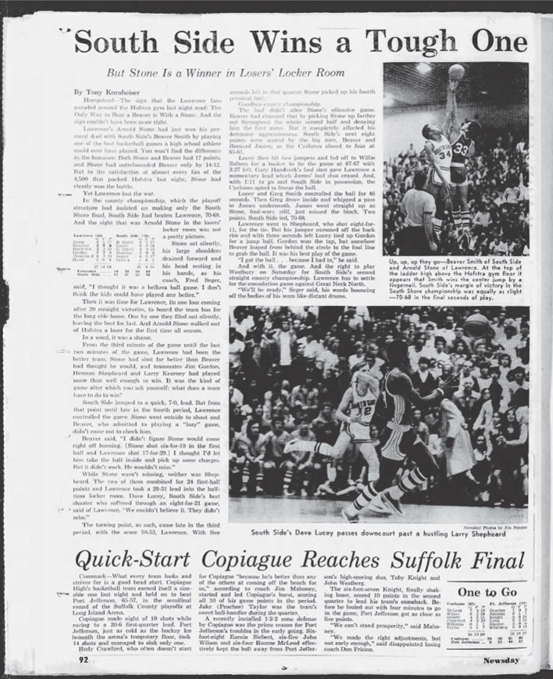
This was a Tuesday evening high school basketball game in March of 1972, a day after I turned 17 years old. It was the Nassau County semi-finals, played at Hofstra in front of more than four thousand, mostly partisan teenagers like me, the largest crowd in New York State schoolboy history. This was Arnold Stone and his underdog Lawrence Golden Tornadoes taking on William “Beaver” Smith and the prior year’s champion South Side Cyclones of Rockville Centre.

I was in 11th grade at Lawrence and had no idea what a golden tornado was or that Georgia Tech football had the nickname for a couple of decades in the early 20th century. Tornadoes. Cyclones. Didn’t give these stormy names a second thought because climate change was just another name for spring break. I knew we were the blue and gold and that was about it. There was of course that Golden Tornado restaurant on the corner of Branch Boulevard and Peninsula Boulevard across the street from Public School No. 6. A lunch hour fried egg sub sandwich with the hash brown potatoes thrown right in. An always welcoming owner named Joe whose alleged penchant for bookmaking reportedly earned some time out from behind the counter. The best pinball machine with real three-dimensional silver metal balls and genuine tilt pronouncements. Most of all, the time to eat and play with friends willing to just stand by the side of the glass and wait their turn.

They’re all gone now, the restaurant, the public elementary school, and yes, Arnold and Beaver.

I had tried out for the team the previous summer of 1971 but needed more inches, more pounds and more talent. The coach was Fred Seger, a basketball and baseball star at Nebraska in the 1950s, ahead of his time in terms of physical conditioning. An intimidating man to anyone who had some growing and growing up to do. When I found out I could walk off as easily as I had walked on, with no one noticing either, I turned to writing about the season for the school paper. This had allowed me to witness an exhibition debacle the prior fall against Suffolk County Brentwood’s Mitch Kupchak of LA Lakers fame that made me glad I was sitting safely above court level with a pen and pad. But somehow, the boys from the Five Towns were here just a few months later playing to the hopes of their mere mortal classmates, some carrying signs that read THE ONLY WAY TO BEAT A BEAVER IS WITH A STONE.

This was years before ESPN, years before its Top Plays, years before Michael Jordan and sneaker deals offered adolescents still in algebra class. Before ticket prices climbed out of reach and before someone had the not great idea to insert radio commercials between baseball pitches. Before one of my favorite movies, Hoosiers, and two of my least favorites, Space Jam and Space Jam: A New Legacy. Long before videogame NBA 2K kept too many people inside. No smartphones, no Snapchatting, no Twitter or TikTok pics. All eyes fixed on a basketball court and a scoreboard.

You can Google South Side 70 Lawrence 68 for the next month and all you will find are real estate listings, temperature readings and restaurant prices. A black and white photo shows the center jump, Arnold wearing number 33 and Beaver 34, bodies fully extended and rising, fingertips stretched towards the heavens, the basketball balanced atop their meeting left hands. Today the commentators would describe this brilliant battle as a shame someone had to lose. The game is gone, long gone, no matter how many jump shots Stone made that day in a valiant effort to take down the champion. Tony Kornheiser for Newsday—yes, that Tony Kornheiser, a few years out of nearby Hewlett High School and a few decades ahead of Monday Night Football and Pardon the Interruption—would take up most of a full sports page to pen a piece entitled South Side Wins a Tough One – But Stone Is a Winner in Losers’ Locker Room.

Beaver Smith would have a fabulous 4-year career at St. John’s, mostly for coaching legend Lou Carnesecca, be drafted in the 5th round by the Knicks in 1976, and play in Europe. Arnold would never quite live up to his own athletic promise in a few years of college ball at Skagit Valley College, Nassau Community College and Jacksonville University. By all accounts both would live rich lives of family and friendships, surely enjoying their past success and attention but never resting or relying on it. Beaver passed away in 2018 and Arnold just last year, both in their 60s, both long before their time.

It is now more than fifty years since that game. The favorite won, the underdog lost. That’s more often than not how it goes. I have always identified with underdogs. I rooted for the Mets, not the Yankees. My father was born into abject poverty and my mother was imprisoned in Europe as a child. I wrote a novel, The Other Side of Losing, celebrating the baseball fans of Chicago who spent a century waiting for a World Series championship, not realizing it was the friendships made along the way that made them winners long before the fickle bouncing balls finally behaved.

The history of competitive sports organization shows an early concern for not tipping the balance from participation towards partisanship too dramatically. The same can be said for society at large. We make too much of teams, of tribes, of races, religions. Of winners. We are all underdogs, all winners and all losers, all in this together, in this beautiful but all too brief game of life.

We have social media now and we see the birthdays, the graduations, the weddings, the anniversaries, the passings. I shake my head and wonder how all those days disappeared so quickly. I don’t really recognize the face in the mirror looking back at me. Every heartburn might be heart failure, tanning freckles the dawn of melanoma, headaches and bellyaches all the possible arrival of that dreaded thing our parents whispered about as the C-word. My friends and I still spend too much time worrying and wondering why the world at large seems as broken as it was when we came into it.  I’ve said goodbye to both parents and to many good friends and family members. And to Beaver and Arnold, two men to whom I owe one very fine evening, that kind of moment that helps add to a good life. After all, if time is going to remain undefeated, it still feels damn good to get your shots up, wherever you are.

_____________________________________________________________________________
About the author
Peter Brav isthe author of the novels Zappy I’m Not, The Other Side of Losing, Sneaking In, and 331 Innings. His shorter work has appeared in Black Fork Review, Kelsey Review, Monarch Review, Echo Magazine, US1 Magazine, Mortal Mag, GreenPrints Magazine, South Florida Poetry Journal, and other publications. He lives on a Central New Jersey farm.

Michael Griffith

The Professor Is Still Talking

“Consider the difference
between the words naked and nude,
or rock and stone,” the professor says.
“Or, for that matter, hug and embrace.”

Pens and pencils move,
but not all of them writing.
Minds are moving, too,
not all of them considering.

My mind moves to you, naked and nude,
and then I remember the rock
         (Or was it a stone?)
that cleaved my head when I was 10.

The solid crack of pain,
the blood in my eyes…

A boy whose name I forget
threw that rock like a deadly Frisbee
and his teasing stopped once he saw my blood.

All his stuttered apologies
lost within my mother’s stony embrace.

My mind moves to you. I think of your hug,
as I think of you nude, not naked.
An ache, not a pain.

I embrace you after I hug you,
after I am made naked before you.

Embarrassed or ashamed?”

The professor is still talking.

_________________________________________________________________
About the author
Michael Griffith began writing poetry in 2016 while recovering from a disability-causing injury. Since then, he’s been published in dozens of online and print venues. Three books of poetry in print: New Paths to Eden, Bloodline, and Exposed. Mike teaches at Mercer County and Raritan Valley Community Colleges.

Jo Sutera

are you there, mom?

her voice reaches me
an other-worldly echo
my daughter is masked
her eyelids flutter
her fingernails dig into the recliner
bags of fluid hang from an IV pole
a ticking machine will titrate the drips

her veins swabbed and exposed
a cancer junkie waiting
for the needle puncture
that will send lethal drugs coursing
through her surgically-insulted body

I am helpless
sliding into a black hole
the only warning – yield

______________________________________________
About the author
Jo Sutera is published in U.S.1, Kelsey Review, Paterson Literary Review and US1 Worksheets, where her poem, “What Do I Want” had been nominated for a Pushcart Prize. She lives in Lawrence, NJ.